Artificial Intelligence (AI) is no longer a futuristic concept; it’s a powerful tool that’s reshaping industries, and education is no exception. But how do we move beyond the headlines and truly harness AI to create more dynamic, effective, and engaging learning environments?
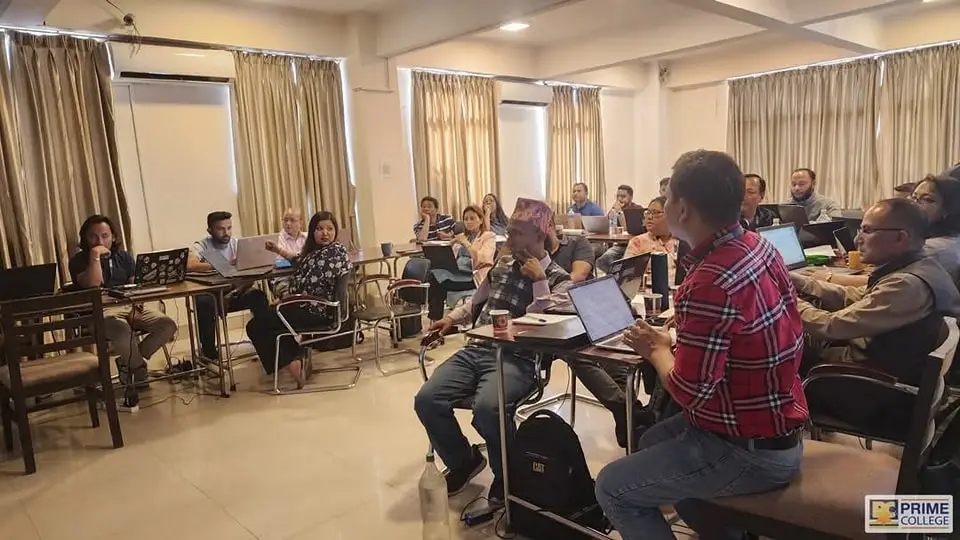
At Prime College, we believe the answer lies in empowering our educators. That’s why our Mathema Learning Resource Center, in a forward-thinking collaboration with the Prime Career Centre, recently hosted an exclusive professional development session: “Prompt Engineering for Educators.”
This wasn’t just another tech seminar. It was a hands-on exploration into the art and science of communicating with AI to get precisely what you need.
Think of an AI tool like a brilliant but very literal assistant. It can do incredible things, but it needs clear, detailed instructions. Prompt engineering is simply the skill of crafting those instructions—or “prompts”—to get the most accurate, creative, and useful results.
For an educator, this skill is a game-changer. It’s the difference between asking an AI to “write about photosynthesis” and asking it to “create a 10th-grade level lesson plan on photosynthesis, including a simple analogy for cellular respiration, three critical thinking questions, and a 5-minute quiz.”
Led by the insightful Amit Sthapit, Director of Career Services at Prime College, our workshop brought together 25 faculty members ready to master this new language. The goal was clear: equip our teaching staff with the skills to leverage AI as a co-pilot in the classroom.
The session was buzzing with energy as participants worked through real-world scenarios. They didn’t just listen to lectures; they rolled up their sleeves and experimented with techniques that could be immediately applied to their courses.
Here are some of the key areas we explored:
A tool is only as good as the person using it. The workshop sparked vital discussions about the broader implications of AI in education. We tackled important topics like AI literacy for students, the ethical considerations of using AI-generated content, and how the role of the teacher is evolving—not to be replaced by technology, but enhanced by it.
Our faculty left the session not just with a new set of technical skills, but with a renewed sense of purpose and excitement. They are now better prepared to lead innovation in their classrooms and guide our students in a world where AI is an integral part.
At Prime College, we are committed to staying at the forefront of educational innovation. By investing in our faculty, we are investing in the success of our students and shaping a future where technology and human expertise combine to create the ultimate learning experience.
Q1: What is the main goal of prompt engineering for educators?
The primary goal is to empower educators to use AI tools more effectively and efficiently. By learning how to write clear and specific prompts, teachers can save time on administrative work, create high-quality, customized teaching materials, design better assessments, and ultimately foster a more engaging and personalized learning environment for their students.
Q2: Will AI eventually replace teachers in the classroom?
Absolutely not. We see AI as a powerful assistant, not a replacement. The human element of teaching—empathy, mentorship, inspiration, and understanding a student’s unique needs—can never be automated. The goal is to use AI to handle repetitive tasks so that teachers can dedicate more of their time and energy to what they do best: teaching and connecting with students.
Q3: What’s a simple example of a prompt a teacher could use?
Here’s a practical example for an economics teacher:
Q4: How is Prime College continuing to support faculty in using new technologies?
This workshop is just one part of our ongoing commitment to professional development. The Mathema Learning Resource Center and Prime Career Centre regularly collaborate to offer training on emerging educational technologies, pedagogical strategies, and industry trends to ensure our faculty and students are always ahead of the curve.